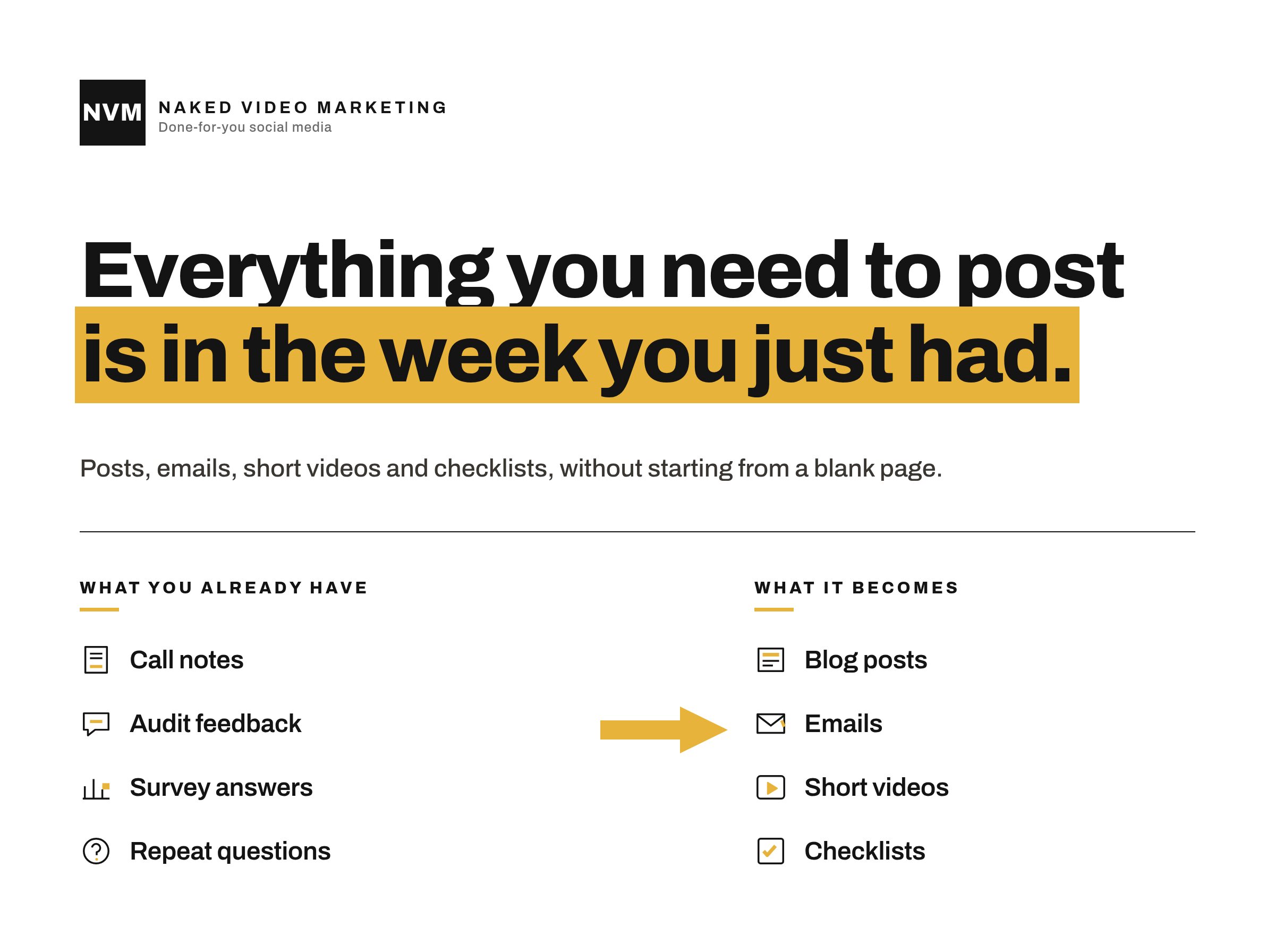
You already have the expertise. The harder part is turning what you know from client work into content when content creation feels like a separate job.
That gap is common for solo coaches, consultants, course creators, and personal brands. You finish a useful conversation, make a sound recommendation, or help someone work through a difficult decision, and then sit down to create content from scratch.
You do not need a separate supply of clever ideas. Your client work already contains real questions, decisions, mistakes, and lessons. Those are stronger starting points than forced prompts because they reflect problems people are trying to solve.
The goal is to extract the reusable lesson, not reproduce anyone’s situation. In this article, you’ll learn how to turn client knowledge into a month of useful content while protecting privacy, staying accurate, and avoiding claims your experience cannot support.
Start with the Work You Already Do
Your calls, feedback, project reviews, audits, and delivery decisions already contain material people can learn from. They are better starting points than broad brainstorming prompts because they come from real questions and real choices, not from trying to guess what might sound interesting.
Pay attention to the explanations you repeat, the concerns that come up in feedback, and the points where you help someone choose a direction. Each one may contain a transferable lesson. You are not turning a client’s project into a public case study or reproducing their situation. You are removing the private context and keeping the useful part: the question, principle, decision process, or correction that could help someone else.
That shift makes content creation less about inventing ideas and more about recognising what your work has already taught you.
Build a Simple Client-Knowledge Capture System
Capture useful observations while they are still fresh, ideally right after a call, project, audit, or coaching session. You do not need a new research process or polished drafts. A few plain-language notes are enough.
- Problem: What was the person trying to solve?
- Initial assumption: What did they believe was causing the problem or what did they think they needed?
- Decision made: What direction, change, or next step did you choose?
- Lesson learned: What could someone else take from this situation?
Keep each answer short. A note such as “They wanted more leads, but the immediate issue was unclear positioning” is more useful than a carefully written summary you never finish. Store these notes wherever you will revisit them: a document, notes app, or simple spreadsheet. Over time, the four prompts create a bank of potential articles, posts, emails, and videos. You are not recording private client details for publication. You are collecting the reusable thinking behind the work.
Find the Questions Clients Ask Repeatedly
Listen for questions clients ask in different words but with the same underlying confusion. One person may ask where to start, while another asks what to prioritise first. Both may need an explanation of how to choose a starting point. Repeated questions are a useful signal: people are looking for help with that issue.
Use the question itself as your starting point or working title. For example, “What should I fix first?” could become an article, email, post, or video about choosing the next practical step. Keep the answer narrow. Address one decision, misunderstanding, or obstacle rather than trying to explain the entire subject. A focused answer is easier to create and more useful to someone facing that specific problem than a broad overview that tries to cover everything.
Notice Where Clients Get Stuck
Pay attention to the points where progress slows down. Clients may have unclear priorities, a weak process, hesitation about the next step, or a problem they are trying to solve at the wrong level. Describe the obstacle in practical terms rather than labeling the person. For example, “They are changing tactics before deciding what the tactic needs to achieve” is more useful than calling someone unfocused.
Build each piece around one obstacle and one useful movement forward:
- Identify the sign of the problem.
- Explain why it tends to persist.
- Offer a practical next step.
This could become a post about choosing a priority, an email about replacing a weak process, or a video about testing whether the diagnosis is correct. Keep the aim narrow. Help the reader spot one obstacle and move through it, rather than covering every reason someone might feel stuck.
Turn Client Decisions Into Teaching Points
The choices you make with clients can become useful content when you explain the thinking behind them. Focus on the trade-offs, sequencing, criteria, and judgment involved, not on the client’s private circumstances.
For example, you might explain why one option was chosen over another, what was deliberately deprioritised, or which criteria mattered most. A piece could explore how to decide whether to simplify an offer before adding another service, or how to choose the next step when several options seem reasonable.
Use generalised decision patterns rather than identifying details. Explain the questions to ask, the constraints to consider, and what might change the recommendation. Avoid presenting one choice as universally correct. The useful lesson is the thinking, not the answer. Show how to weigh the same trade-offs when a similar decision comes up.
Use Mistakes Without Making Clients the Story
Mistakes and failed approaches can become useful content when you treat them as patterns in the work, not stories about a particular person. Explain what the approach was, why it seemed reasonable, what went wrong, and what changed afterward. Then make the lesson practical for the reader.
Before writing, run a privacy check:
- Remove names, business specifics, timelines, and other identifying details where relevant.
- Do not imply that anonymising the situation gives you permission to share it.
- Keep the focus on the approach, correction, or decision, not on the client.
You might write about why adding more tactics did not solve the underlying problem, or how changing the order of steps improved the work. Describe the general lesson without presenting it as proof that the same outcome is guaranteed for everyone. The goal is to help readers recognise a common failure pattern and understand what to try differently.
Convert Your Methods Into Clear Explanations
Notice what you explain more than once during delivery. It might be a question you ask, a checklist you use, a distinction that prevents confusion, or a framework that helps someone choose a direction. These repeated explanations are useful content once you separate them into smaller parts.
Take one method and isolate one element at a time:
- One question to ask before taking action
- One step in a process
- One distinction that helps someone diagnose an issue
- One checklist for reviewing a decision
Use plain language and give each piece one concrete outcome, such as helping the reader choose a next step or spot a common issue. You do not need to publish the entire framework. A clear explanation of one useful part is easier to understand and more likely to be used than an overbuilt system full of jargon.
Add Evidence Without Inventing Proof
Your content can be grounded in practice without pretending that practice proves everything. Describe what has come up repeatedly in your work, such as a question clients often ask or an obstacle you have seen more than once. Precise language keeps the claim accurate: “In my work, I often see…” is different from “This always happens.”
Do not invent numbers, outcomes, testimonials, or causal claims. Avoid turning an unverified client story into a polished case study, implying a guarantee, or suggesting that one decision produced a result you cannot confirm. A useful observation can stand on its own. You can explain a pattern you have genuinely noticed, then offer a practical way to think about it, without presenting it as universal proof. Keep examples generalised, privacy-safe, and verifiable from your actual experience.
Create Multiple Pieces From One Client Insight
One generalised insight can support several pieces when you change what the reader needs rather than the wording. Suppose you notice that people often try to add more tactics before deciding what their current tactic needs to achieve.
Problem-focused piece
Explain the sign of this problem and why adding more activity may not resolve it. This answers, “Why am I busy but still unclear?”
Practical checklist
Give readers a short list of questions to answer before adding another tactic. This answers, “What should I check first?”
Myth correction
Challenge the idea that more options automatically create progress. This answers, “What assumption might be misleading me?”
Decision guide
Show how to choose between refining the current approach and starting something new. This answers, “Which direction should I take?”
Reflection
Explore what the pattern has taught you about sequencing work. This answers, “What should I remember next time?”
Each piece uses the same insight but creates a different useful outcome, giving you more content without repeating the same explanation.
Turn the Process Into a Weekly Routine
Make this a review-and-draft habit, not another content production system. Once a week, set aside a short block to:
- Review recent calls, projects, audits, or notes and look for questions, decisions, or lessons that may help someone else.
- Choose one insight. Do not try to process every note or turn every observation into content.
- Draft one useful piece focused on a single reader need, such as understanding a problem or choosing a next step.
- Save the unused questions, decisions, and lessons in one simple document, notes app, or spreadsheet for later.
If a busy week leaves little time, review one conversation and write a short post. If projects are irregular, use whichever recent client work is available. The routine should support delivery and business decisions, not compete with them.
Consistent content does not require a separate stream of clever ideas. The questions, decisions, mistakes, and lessons already present in your client work can give you a month of useful material. The solution is an extraction habit, not more brainstorming: notice what your work is teaching, then share the reusable lesson clearly and carefully. Protect client confidentiality, remove identifying details, and avoid overstating what your practice proves.